Showing posts with label Newfoundland. Show all posts

08 May 2013

The Re-birth of the Stupid Newfie


[A version of the following was published by The Telegram on 8 May 2013]


The Re-birth of the Stupid Newfie
by
Jeff Rose-Martland

The Dunderdale government likes to yammer on about investing in our future: hydropower and industry and jobs galore.  A future of resources and trade and high employment.  A debt-free future, according to their budget.  But do they care what kind of Newfoundlanders will live that future?

Harken back to the early- to mid-20th century.  Newfoundlanders were the butt of jokes throughout
Canada, if not the world - The Newfie Joke.  The jokes revolved around a central theme: the Stupid Newfie.  Sometimes, the protagonist was someone so dense that simple situations were beyond their grasp.  Most often, the Stupid Newfie had a great deal of common sense, but was ignorant, unworldly, and uneducated.  The character would attempt to apply this simple reasoning to complex situations.  Oh, the hilarity.

Those jokes had some basis in fact.  After all, Newfoundlanders during that time were, by and large, uneducated academically.  They fled poverty to distant locations for jobs.  Newfoundlanders brought our hard working nature, but also our tendency to dive in, even when over our heads, especially if there’s money involved.  Anyone faced with a brand-new situation is likely to say or do the wrong thing, and Newfoundlanders are an especially humorous people, so it is easy to see how comic situations might result.  But the Newfie joke quickly morphed into a vehicle of bias and intolerance, with the people of this province branded ‘stupid’.

We have had a long, hard fight against that reputation.  We object to the term ‘Newfie’ as offensive.  We are quick to point out the cutting-edge medicine, science and engineering being done here.  We boast of Memorial University’s rank as a top-notch school.  We push the message that the Stupid Newfie is no more.  We are winning, but have not yet won.

The Dunderdale government is going to resurrect the Stupid Newfie.  Amongst all the talk of resource projects and deficit reduction, the PCs are acting to turn us ignorant again.  And, with only limited objections, we are happily boarding the train with them back to Stupid Newfoundland.

Adult Basic Education – a program designed to help anyone who dropped out of high-school.  Not so many years ago, ABE had been handled by private institutions.  They dropped the program because they couldn’t make enough money.  It was government that moved ABE into CONA, to ensure the program would be available throughout the province to those who need it.  By dumping ABE back to the private sector, Kathy Dunderdale has effectively killed the program - it won’t be too long before private schools announce - again - that Adult Basic Education is not profitable.

Lack of ABE programs will mean more people stuck with whatever education they got when they quit grade school; low education is a primary qualification for the Stupid Newfie.

Then there’s the libraries.  We have 96 of them.  We need more because libraries are wonderful places.  First, everything is free – something one appreciates in this crazy world of unreliable income.  Second, libraries don’t just have books; they have videos and music and Internet.  The are one-stop-shops for entertainment.  Libraries also host courses, sessions, groups, lectures, readings – all sorts of ways to have fun and learn more. 

Also, the Librarian.  (That’s capitalized because it should be a title, not a job description.)  Librarians are rare people.  They not only know things, they know how to learn more about things.  They hold the keys to finding out anything you ever wanted to know.  They might appear to spend their time tidying the books and calling the overdue borrowers.  They may seem to be quiet people armed with date-stampers.  But Librarians are some of the most important people in our society.  Librarians are the guardians of all our accumulated knowledge. 

Disagree?  Go ask one a question.  Any question.  You’ll get the answer, in detail, with annotations and cross-references.  And an Librarian doesn’t care if you are 6 and in Grade 1, 46 and a doctor, or 86 and a war vet.  They will help anyone, free of charge.  Because a Librarian is your guide through the Kingdom of Knowledge. 

But Kathy Dunderdale doesn’t think that’s important.   She must feel that librarians are not important for our future, since she laid off 40% of them.  Plus support staff - assistant librarians and IT people.  And she cut the modest wages of those who remain, making this an even less-attractive field.  Libraries, we have been assured, will still have funding for books and will remain open.  How that is going to work?  There won’t be a Librarian to buy the books, nor assistants to man the counter and keep the doors open.. 

The system has already been scuttled; the Conservatives have rendered libraries unsustainable.  In five years, maybe less, government will be able to closing the doors, claiming lack of use.  Which there will be, as out-of-date materials, lack of programming, erratic hours, and, above all, no Librarians to guide people all combine to drive patrons away.

That doesn’t matter to the PCs.  After all, libraries don’t generate revenue.  Neither does sitting in a classroom - one need only look at the number of education cuts to see government’s view on that.  Dunderdale is promising jobs while slashing away at the tools we need to obtain that employment.  Are we to become janitors at Muskrat Falls?  General labourers for rich, Come-from-Away bosses?  Is she planning on making a personal fortune selling Newfie Joke Books?

If we really are concerned about our future, if we really want to excel and exceed, then we need to have smart, educated people.  The way to get them is to invest in education and libraries.  Learning needs to be available to all, not just those with funds.  Otherwise, the rich get educations and the poor get ignorant.

The Dunderdale Government says it cares about our future, but its actions are ensuring we will only have one role in it: The Stupid Newfie.

--------------------

Jeff Rose-Martland is an award-winning author, member of the Newfoundland Writers’ Guild, and recipient of the Queens Diamond Jubilee Medal for his work advocating for veterans.

13 January 2013

Whaddyamean, You Can't Boil Water???

During this week's stormI was - and still am - appalled to hear the number of calls to local radio from people bemoaning the blackout and their consequent lack of hot beverages.  My opinion on being prepared I will share further down, but I will say that it is a horrific state of affairs when a Newfoundlander can't figure out a boil-up!

So, in order to preserve the dignity of our culture, here are some links to help you poor things:

Stoves - These can be easily made with stuff you have on hand already and will at least boil a cup of water and/or heat some soup

Pocket Stove

Large Can Camp Stove

Pet-food Can Stove

Stay-Warm Stove


Super-Easy Can BBQ

Boil your kettle with tea lights!


Lamps - Say you don't have any candles or spare batteries for the flashlight and your cel phone is about to die because you've been using it as a light source.  Don't sit in the dark!  Here are some easy emergency lamps.

Popcan Lamp


Shortening Lamp - Basically, you stick a wick in a tub of lard.  You can also do this with butter, bacon fat, or any other solid fat.  You can use practically any woven string or cord for a wick, provided it is natural fiber - nylon, for example, just melts.  Your wick needs to burn and drawn the melted oil into it.  If you are desperate, POWs in WWII used to use twisted strips of cotton shirt.

Improvised Oil Lamp - This is the simplest of the simple: something to use as a wick, a bit of wire to hold the wick, a mug, and something flammable (oil, vodka, etc).

Think you don't have ANYTHING to make a lamp out of?  How about a orange?  (Yes, I've tried it and it works.)
Citrus Candle

And, of course, if you can get enough heat from your lamp, you can probably boil water over it.  Be patient, though.  Low-heat lamps/candles take time to cook things.


BE PREPARED!!!


No matter where you live or how modern your city, sooner or later, the electricity will go out - that is a fact of life.  Look around you.  See all those things running on batteries and plugged in to the wall?  Consider every one of them useless in a blackout.  What are you going to do now?

First thing: don't panic.  Good advice at any time.

Second thing: remember that humanity has survived for hundreds of thousands of years without electricity, so you should be able to last a few hours or even days.

Third thing: Be prepared.  You know this is going to happen, eventually.  So take a few minutes and a bit of money and get ready for it now.

Fourth Thing: Make a list of what you will need, then get it.  Don't forget to include 'luxury' items.  It's fine to have canned food (don't forget the manual can opener), but what about your morning coffee?  Some way to make toast?  Something to DO during the blackout?  These are all important.  Otherwise, you will find yourself just sitting around staring at the oil burning in your orange.

Fifth Thing: Keep your emergency kit stocked and accessible.  Over time, if it has not been used, there is a tendency to dip into the kit for bits and bobs and/or to bury it in storage under the xmess decorations and old toys.  Don't do either of these.  Once you have build your kit, keep it stocked.  Rotate the batteries for fresh every year.  Leave the canned goods alone - they are good for 50 years.  Keep your kit in 1 place, don't keep moving it.  Keep it someplace you can find in the dark.  


Emergency Kit Items

How you fill your kit is up to you, but here's some ways to get started.

Questions:
What will I need to be able to see?
What will I need for heat?
How/what will i cook?
How will I make my morning coffee/tea?
What will i do to occupy the kids?
How will I keep myself busy?

(You get the idea, i'm sure you can think of more.)

Low-cost Options:
If money is an issue, here's the basics:

- A large package of tea-light candles

- A tea-light fondue set (or one of the DIY stoves above)

- a can of Sterno (jellied alcohol fuel, provides heat and an alternate way to cook)

- 2 decent LED flashlights+batteries (stored separately)

- A battery powered AM radio+batteries stored separately (if you check you local stations, you'll find at least 1 AM station that delivers mostly news and that stays live during storms.  FM, not so much, although markets vary.  In any event, get a radio that gets AM or both AM and FM.  FM stations frequently just run computer programs which don't much care if your lights are out.)


- a pack of cards / travel chess / book you-always-mean-to-read-but-never-start

- if you have small kids: several packs of plastic animals/dinosaurs/soldiers, teddy bears, toy cars, doll, etc.  The important bit is that these be new to the kids (buys you several hours peace) and will occupy their imaginations (which you may need to pull-start as the video games are not working).  New teddys/dolls etc can give your kids a new friend to share the blackout with; a friend you can declare is not afraid of the dark and that's why they live in the emergency box.

- canned & dried food: beans, weiners, soup, instant oatmeal, etc.  Get stuff you like, enough for 2 days.  Packets should be stored in a ziplock bag to keep it dry (and to block interloping bugs).  Anything which can be cooked as-is or just-add-water.  Sure, you will have food in your house already, but you may not be able to cook that frozen roast.  And there's no need to be eating cracker sandwiches just because you generally avoid pre-made meals.  Don't forget the canned milk.

- Manual can opener - Get a crank-handle one.  Also get a 'church key' punch/bottle opener.  Leave them in the kit!

- Matches+lighter - get some of each.  You can turn normal matches into waterproof matches by showing them in a ziplock bag.  Lighters work better for some things and they last longer; matches work better for others.

- Most important: tea bags and instant coffee and hot chocolate.  It may not taste as good as usual, but if you need your morning caffeine, you'll drink it and be grateful.  Hot chocolate makes a good treat for anyone, especially kids.

- 1 plastic bin with lid to keep everything in

Most of these items can be purchased at your local dollar store, so start there.  Sterno is available from most camping/outdoor/kitchen supply stores (its used to warm food trays and in fondues).  If you are frugal, this entire kit should come in between $20-$30CDN.

Higher Cost Options:
One you have your basic kit, you can add options to it over time so as not to break the bank.  Pick up 1 or 2 things a moth, or a quarter, and you will soon be set.  Look for post-season sales: oil lamps are popular xmess decorations so get those Boxing week; camping gear goes on sale in August; etc.

Light:
- Oil (hurricane) lamps or lanterns + oil.  Price varies, but you can readily find lanterns for $5-$10 and small lamps at dollar stores, large ones run $10+.  Get enough to cover the common areas of your house, bathrooms can use candles or flashlights.

- Propane-, butane-, and other fuel-lamps are available.  The advantage of your basic wick-and-oil lamps is that it will burn a variety of fuels, from lamp oil to alcohol, whereas the others can only handle 1.  However, propane lanterns give off a great deal of light and heat. But they also produce CO, so you need to be careful.  There as also napatha lanterns, but read under stoves for the reasons to avoid.

-Flashlights - thanks to advances in LED technology, flashlights now run for a very long time on small batteries.  You can also get big versions, which will serve as lanterns and lamps.  Make absolutely sure that you have at least 3 sets of batteries for each and that you change the batteries in the kit every year.  Downside: you don't get heat from a flashlight.  Other options will keep your home warm and perhaps even provide a means for cooking.  Still, since you don't want to send a 5-year-old to bed with a candle, keep a few flashlights in the kit.

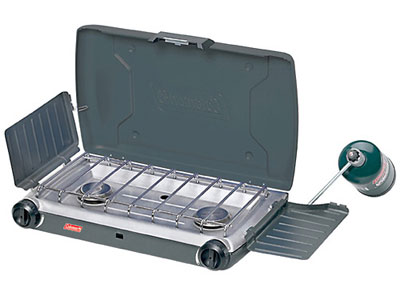
- Propane camp stove - these vary greatly.  The single-burner, no frills variety runs $15-$25CDN.  It will boil a pot of water, a kettle, or heat a frying-pan.  The common 2-burner type behaves like a typical gas-range and runs $40-$100 depending on brand and options.  Stoves go up from there with more burners and frills, but unless you are expecting a gourmet chef to be hosting your blackout, a 1- or 2- burner will do find.

- Other stoves include butane-powered burners, which operate much the same.  You can also use a fondue set (not just for New Years Eve anymore!) as a single-burner stove.  you can even substitutes a frying pan for the normal pot.  "White gas" - napatha fuel - camping gear CAN be used, but should be avoided.  It produces more carbon monoxide than propane and the pressuring pumps can create a fire hazard.  (Not such a big deal in the great out doors; definitely a big deal in your great kitchen).  You can also find units which run on pressurized alcohol, which produces no CO (same as fondue fuels) if the media has you terrified about carbon monoxide.  (Really, these things are safe if you are sensible.  Don't run the stove all day.  When in doubt, open a window.)  And there's always your backyard grill!

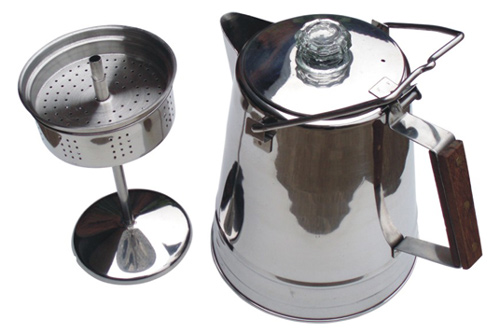
- Tea/Coffee pot.  Depending on your preference, you may need to provide for this.  You can get all sorts of metal teapots which can sit on a burner or on your regular stove.  They will boil your water for bagged tea, instant oatmeal, dehydrated food, etc.  If you prefer something fancier, there are a variety of tea-diffuser options.  Just make sure you have a way to boil the water.  Coffee is a bit trickier.  If you like instant, you are off the hook (and out of your mind).  If your tastes are more refined, here's your options: French Press (Bodum), old-fashioned percolator, drip, or simple espresso.  I prefer the espresso: a pot can cost as little as $8 and works all the time, just add heat. (Note: I once saw a camping item for coffee - it was a thermos that you filled with boiling water, coffee in filter, and hung from a tree.  It used gravity to drip your coffee.  unfortunately, i can't find it online.)

- battery powered radio with mp3 player or bluetooth options - you can flip between the news and your own music.

- Battery powered DVD player, laptop computers, etc, can all be useful, but you will want to invest in some sort recharging method.  Simplest one is a power-inverter for your car - plugs into the cigarette lights and you can plug normal things into it.  (It also gives you an excuse to sit in the car and avoid the whining inside.)  Just remember to run your car engine, or you'll soon be needing a charger for that as well.

-As your budget expands and your children grow, you can dump the toys in favour of Monopoly, Scrabble, or other family-games, and add books for them as well.

Cool Gadgets


Tea-Light Grill - I've seen a variety of versions of this.  The best one folds up into a package about 6"x3"x1/2" thick - perfect for sticking in a pocket or glove compartment or backpack and forgetting about... until you need it.  The one shown is being used to melt cheese, but they will also cook eggs, bacon, fish, chicken, beef, burgers....basically, if it is less than an inch thick and will fit on the pan, you can cook it.  You should also be able to boil water by resting an appropriately-sized can or small pot in pace of the grill.  Price is around $10.

Zen Fireplace - There are a wide variety of these, designed for indoor use.  They run on gellied ethanol/fondue fuel.  Look great and provide heat. Prices start at $15.

There are a whole lot of cool/interesting gadgets for providing heat and light, for cooking, and for re-charging your cel phones/media players/notebooks.  Check your local military surplus stores, camping suppliers, and any place that sells products for going 'off the grid'.

Final Word

While we may live in a modern, electronic world, it does not take much to send us back a few hundred years...or a few thousand.  A downed power line, a car stuck in the snow, any number of situations can put us back to the old days.  How far you are willing to be pushed back is up to you.  With preparation, you will only have to slide a few decades, perhaps not even that far.  But unprepared and unthinking can drive you all the way back to prehistory: sitting in the dark, eating cold scrounged food, and trying to keep warm.  And you are even less-prepared than an early human, since you don't have their skills.

So take a few hours and get ready.  You won't need the kit often, but you will need it.  And when you do, you will be extremely happy to have made the investment.

And for the Newfoundlanders:  Lardtunderin b'ys!  Gitoffyerbutts n git yer gear!  Doan be callin' da media complainin'.  Yer a h'embarassment!  Our h'ancesters came here wit frig all n made it tru; yer moanin' cause ya can't do a boilup???  Whadahells wrong wit ya????


01 July 2010

The Last Post


There have been seriously conflicting emotions in Newfoundland about 1 July ever since we joined confederation. On 1 July 1867, Canada moved from being a British possession to being a country. Naturally, 1 July is Canada Day - a day to celebrate the country and what it means to be Canadian.


However, Newfoundland sees the date rather differently. On 1 July 1916, the opening day of the Battle of the Somme in the Great War, 801 soldiers of the Newfoundland Regiment went over the top at Beaumont Hamel in France. The Regiment was almost eradicated in 30 minutes by German crossfire. Yet, despite the mounting numbers of dead and wounded, the Newfoundlanders still fought hard to achieve their impossible objective. “The only visible sign that the men knew they were under this terrific fire,” wrote one observer, “was that they all instinctively tucked their chins into an advanced shoulder as they had so often done when fighting their way home against a blizzard in some little outport in far off Newfoundland.” Over 500 of the 710 casualties died, but as they were being carried to field hospitals, or lying near death, the Newfoundlanders only had one concern: Is the General pleased?


At roll call the following morning, only 68 members of the regiment answered the call. "It was a magnificent display of trained and disciplined valour, and its assault failed of success because dead men can advance no further." said the Divisional Commander of the Regiment’s effort. For this single action, the Regiment was granted ‘royal’ status. But the cost was huge: a significant portion of the small dominion’s generation.

Naturally, 1 July became Newfoundland’s memorial day. That is, until we joined Canada. Ever since, we have been torn; do we celebrate or mourn?

The answer is, both. Currently, activities on 1 July go as follow: sunrise ceremony making Canada Day, as we are the first province to get dawn. Then, morning activities consist of wreath layings and memorial services. Afternoon reverts to Canada Day celebrations. Every year, though, people complain about this combination.

For me, I see no problem with doing both. Beaumont Hamel must be remembered, marked, reflected upon. But I can guarantee that those who fought on that day, being Newfoundlanders, would have loved an excuse for a good party. Likewise, we should be proud of being Canadians. Canada is a wonderful country. A nation built upon understanding, consensus, compromise, and agreement. Every province joined by signature, not force. This sets the tone for the nation; we work things out, find appropriate solutions, and do not resort to force. Our reaction to those who do take up violence to make their point tends to be swift, harsh, and condemning. As with the FLQ Crisis, Oka, and most recently, the G20 summit, Canadians do not accept violence as a means of protest. If there is any one thing which is likely to unite opinion from coast to coast to coast, it is this. We don’t fight. We work things out.

Which is why the combination of Memorial and Celebration on 1 July makes sense to me. No one can help that 2 very different and very significant events occurred on this date. To relocate one event to another place in the calendar would be to do a disservice to that event. So we mark both, we mourn and remember and party and celebrate. And that’s as it should be.

A final word on The Great War. This is perhaps the most important conflict in human history, yet it is frequently overshadowed by other conflicts, particularly World War II. We would rather remember the second war. Owing to Nazi atrocities, we can safely and comfortably declare that the Allies were not only victors, but just in their victory. Hindsight lets us justify our violence, World War II in Europe clearly had good guys and bad guys and the good guys won. A wonderful epic which has been used by governments ever since to justify sending troops.

The Great War is very different. There is no clear reason for its beginning. It ended with capitulation rather than victory. There was really no right or wrong side, no good or bad, no black or white. Most of the war involved people dying over stretches of land no further than the corner store. Horrible weapons were used: machine guns, gas, flamethrowers. Millions died. And, in the end, nothing was really achieved by either side.

This makes remembering that war very awkward. We don’t like to be confronted with the idea that war may be useless, that we can never achieve anything by force. We desperately want to have faith that fighting will fix things. Negotiating and compromise is hard; fighting an easy default. We want heroes and villains, not a bunch of similar people dying because a monarch or government is unreasonable.

But this is exactly why The Great War is so important: it proves war’s futility. It also proves that we are not so different. Frequently, opposing forces would exchange pleasantries during breaks in the fighting. Troops singing to each other across no-mans-land. Christmas celebrations were enemies met and exchanged gifts, had pictures taken with each other. Post-battle analysis, when commanders would give credit to the enemy for a battle well fought, like teams shaking hands after a game. Soldiers would die and kill for their countries, because that was their role, but, despite the hatred that is inevitable for one who is trying to kill you, soldiers were also able to stand around, shake hands, exchange knowing looks that said, “I don’t know why we’re fighting either.” And this is a very important lesson. Soldiers, men and women, are unique and should be honoured for their ability to answer the call, to risk everything, because we have asked them to do so. But in honouring them, we, as citizens, must ensure that their sacrifice is meaningful and necessary, not dumb and futile. We must watch our governments closely, guard our emotions carefully, and ask if we cannot find a better alternative to combat.

During the Great War, in Gallipoli, Turkey, fighting was intense and fruitless. British forces - among them, Australians, New Zealanders, and Newfoundlanders - tried to force their way uphill and overland, attacking entrenched positions. Above, in the hills, the Turks held the high ground but were under supplied. Fighting was intense, supplies scarce for both forces. Commonwealth troops displayed many acts of bravery, as did the enemy. Mustafa Kemal Ataturk, Turkish commander, told his soldiers at the opening engagements of Gallipoli: "I am not giving you an order to attack, but I am ordering you to die!" Which the Turks did in great numbers, their sacrifice buying time for reinforcements to arrive.

Is their sacrifice any less significant than that of the Newfoundlanders at Beaumont Hamel? Is it less than those of the ANZACs at Gallipoli? No. And that is most significant - both forces are equally capable of bravery or atrocity, both are human and equal. Is it not true, then, that war should be needless?

In 1934, Ataturk erected a monument for Gallipoli. The inscription read: "Those heroes that shed their blood and lost their lives...you are now lying in the soil of a friendly country. Therefore rest in peace. There is no difference between the Johnnies and the Mehmets to us, where they lie, side by side here in this country of ours. You, the mothers who sent their sons from faraway countries wipe away your tears. Your sons are now lying in our bosom and are in peace. After having lost their lives on this land, they have become our sons as well." I have not seen any similar tribute, any equal monument, which honours and respects both sides of a conflict. (If you have, e-mail me, please!)


Canada is a nation of settlement, of agreement, the nation which invented peacekeeping. We all fundamentally believe that violence is wrong and that it must stopped, even if we need to become violent to do so. While we mark Canada’s nationhood, it is only fitting that we also reflect on this fact. Newfoundlanders and Canadians all, we should take time today to think about our military, the cost of conflict, and the meaning of the Great War. If you cannot attend a memorial, take time to think, make an effort to learn, search out information on the Somme, play the Last Post on your ipod. One thing is absolutely sure: The first day of the Battle of the Somme did as much to shape Canada as the British North America Act.

And we will remember.


Links for more info: